Tax Obligations: US + Mexico (Dual Filing)
If you are a US citizen or green card holder living in Mexico, you owe taxes to both countries. The US taxes worldwide income regardless of where you live — this obligation does not end when you move abroad (IRS Publication 54). Mexico taxes residents on worldwide income once you establish tax residency.
When does Mexican tax residency start? Mexico uses a 183-day rule. If you are present in Mexico for 183+ days in a calendar year, or if your "center of vital interests" (primary home, main source of income) is in Mexico, you are a Mexican tax resident. At that point, you must register for an RFC (Registro Federal de Contribuyentes) at a SAT office.
Mexico's Progressive Tax Rates (Régimen General) — 2026
| Income Range (MXN) | Marginal Rate | Approx. USD Equivalent |
|---|---|---|
| $0 – $8,952 | 1.92% | ~$0 – $500 |
| $8,953 – $75,984 | 6.40% | ~$500 – $4,200 |
| $75,985 – $133,536 | 10.88% | ~$4,200 – $7,400 |
| $133,537 – $155,229 | 16.00% | ~$7,400 – $8,600 |
| $155,230 – $185,852 | 17.92% | ~$8,600 – $10,300 |
| $185,853 – $374,837 | 21.36% | ~$10,300 – $20,800 |
| $374,838 – $590,795 | 23.52% | ~$20,800 – $32,800 |
| $590,796 – $1,127,926 | 30.00% | ~$32,800 – $62,700 |
| $1,127,927 – $1,503,902 | 32.00% | ~$62,700 – $83,600 |
| $1,503,903 – $4,511,707 | 34.00% | ~$83,600 – $250,700 |
| $4,511,708+ | 35.00% | ~$250,700+ |
These are marginal rates — only the income within each bracket is taxed at that rate. For most Americans earning in the $40,000–$80,000 USD range, the effective Mexican tax rate under the general regime lands between 15–25%. This is why RESICO (below) is so valuable — it replaces this entire bracket system. For a deep dive on avoiding double taxation with the US-Mexico treaty, see our full double taxation guide →
RESICO Regime — Mexico's Simplified Tax for Self-Employed
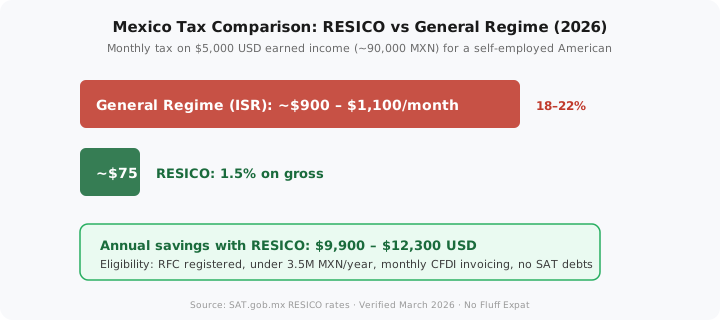
RESICO (Régimen Simplificado de Confianza) is a simplified tax regime available to Mexican tax residents with annual business/freelance income under 3.5 million MXN (~$195,000 USD). It replaces the progressive brackets above with dramatically lower rates on gross income (not net profit).
| Monthly Gross Income (MXN) | Tax Rate | Approx. USD Equivalent |
|---|---|---|
| $0 – $25,000 | 1.00% | ~$0 – $1,390 |
| $25,001 – $50,000 | 1.10% | ~$1,390 – $2,780 |
| $50,001 – $83,333 | 1.50% | ~$2,780 – $4,630 |
| $83,334 – $208,333 | 2.00% | ~$4,630 – $11,570 |
| $208,334 – $291,667 | 2.50% | ~$11,570 – $16,200 |
Why this matters for Americans: A freelancer earning $5,000 USD/month (~90,000 MXN) under the general regime would pay roughly 18–22% in Mexican income tax. Under RESICO, the same income is taxed at 1.5% — roughly $75/month vs $900–$1,100/month. The savings are enormous.
RESICO Eligibility Requirements
To qualify, you must meet all of the following:
- RFC registration — you must be registered with SAT as a persona física (individual)
- Annual income under 3.5M MXN (~$195,000 USD) from business/professional activities
- Mexican tax resident — 183+ days in Mexico or center of vital interests here
- Issue CFDIs (electronic invoices) for all income — SAT requires digital invoicing
- File monthly declarations — pagos provisionales due by the 17th of each month
- No outstanding SAT debts — you must be current on all filings
FBAR & FATCA Penalties for Americans in Mexico
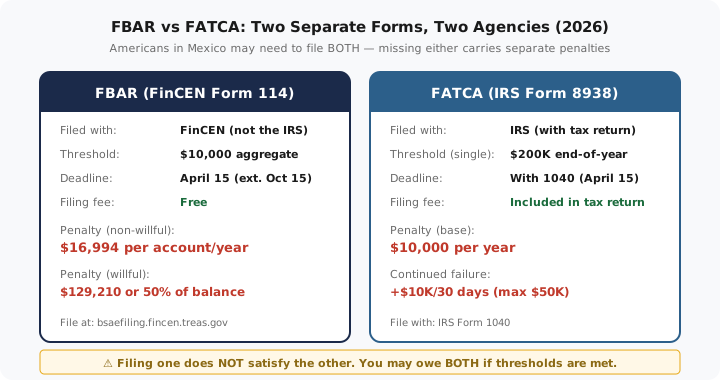
Two separate US reporting requirements apply to Americans with Mexican bank accounts. Failure to file either carries severe penalties — and the IRS enforces these aggressively.
FBAR (FinCEN Form 114)
If your Mexican bank accounts exceed $10,000 in aggregate at any point during the year, you must file an FBAR. This includes checking, savings, investment, and retirement accounts — even accounts where you only have signature authority. The $10,000 threshold applies to the combined maximum balance across all foreign accounts, not per-account.
| Violation | Penalty | Notes |
|---|---|---|
| Non-willful failure to file | Up to $16,994 per account/year | Adjusted annually for inflation — was $10,000 originally |
| Willful failure to file | Greater of $129,210 or 50% of account balance | Per account, per year — can exceed the account value |
| Criminal willful non-filing | $250,000 fine + 5 years imprisonment | Per 31 USC §5322 — rare but not unheard of |
Filing deadline: April 15, with automatic extension to October 15 for all filers. Filed electronically through FinCEN BSA E-Filing. This is separate from your tax return — it goes to FinCEN, not the IRS.
FATCA (Form 8938)
FATCA requires reporting on IRS Form 8938 (Statement of Specified Foreign Financial Assets). The thresholds for Americans living abroad are higher than for US-based filers:
| Filing Status | End-of-Year Threshold | Any-Time-During-Year Threshold |
|---|---|---|
| Single / Married Filing Separately | $200,000 | $300,000 |
| Married Filing Jointly | $400,000 | $600,000 |
FATCA is filed with your tax return (Form 1040), not separately. Penalty for non-filing: $10,000 per year, plus an additional $10,000 for each 30 days of non-filing after IRS notice (max $50,000). For the complete FBAR and FATCA filing walkthrough with Mexico-specific examples, see our FBAR & FATCA from Mexico guide →
How to Avoid Double Taxation — FTC vs FEIE
Americans in Mexico have two main tools to avoid paying income tax twice on the same money:
Option 1: Foreign Earned Income Exclusion (FEIE — Form 2555)
Excludes up to $132,900 (2026) of earned income (salary, freelance, self-employment) from US taxation. You must pass either the Bona Fide Residence Test or the Physical Presence Test (330 full days outside the US in a 12-month period). Does not apply to passive income (dividends, capital gains, rental income, Social Security).
Option 2: Foreign Tax Credit (FTC — Form 1116)
Credits the taxes you paid to Mexico against your US tax bill, dollar-for-dollar. Works for all income types, including passive income. More complex to calculate but often more beneficial for higher earners or those with mixed income sources.
| Factor | FEIE (Form 2555) | FTC (Form 1116) |
|---|---|---|
| Max benefit (2026) | $132,900 excluded from US tax | Dollar-for-dollar credit for Mexican taxes paid |
| Income types covered | Earned income only | All income types (earned + passive) |
| Residency test | Bona Fide Residence or 330-day Physical Presence | None — just prove you paid foreign tax |
| SE tax relief? | No — still owe 15.3% SE tax on excluded income | Can offset SE tax in some cases |
| Complexity | Simpler | More complex but often saves more |
| Best for | Moderate earned income under $132,900 | Higher earners, mixed income, or high Mexican tax paid |
Most common strategy: Americans in Mexico with earned income under $132,900 use FEIE to zero out US income tax on that income, then use FTC for any remaining Mexican taxes paid on other income. A US expat CPA can model both scenarios with your actual numbers — the difference can be thousands of dollars.
Visa Options & Income Thresholds — 2026
Mexico offers several visa paths for Americans. The income thresholds below are based on INM (Instituto Nacional de Migración) requirements verified for 2026. Thresholds change periodically — check gob.mx/inm for the latest figures.
| Visa Type | Duration | Income Requirement | Key Notes |
|---|---|---|---|
| Tourist (FMM) | Up to 180 days | None | No work permit. Cannot open bank accounts at most banks. No RFC. |
| Temporary Resident | 1–4 years (renewable) | ~$2,600–$4,400/mo or $40K–$74K savings | Varies by consulate (UMA-based from 2025). Can get RFC. |
| Permanent Resident | Indefinite | ~$4,400–$7,400/mo or $130K–$300K savings | Full rights. No renewal. Path from 4yr temporary. |
| Work Visa (sponsored) | Tied to employment | Employer handles | Must have a Mexican employer or legal entity. |
For a full breakdown of each visa option and the tax implications of switching between them, see our Mexico Visa & Residency 2026 guide → Considering other countries? Compare with Portugal's D7/D8 visa system or Panama's Pensionado visa.
Cost of Living by City — Comparison Tables (2026)
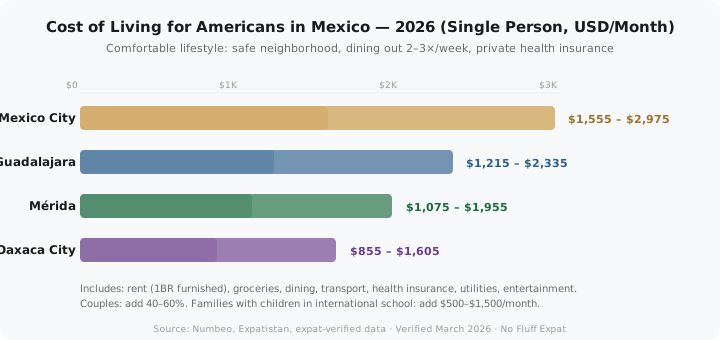
These figures represent realistic monthly costs for an American living a comfortable (not luxury) lifestyle in Mexico. "Comfortable" means a furnished 1-bedroom apartment in a safe neighborhood, eating out 2–3 times per week, private health insurance, and modest entertainment. All figures in USD.
| Category | Mexico City | Mérida | Oaxaca City | Guadalajara |
|---|---|---|---|---|
| Rent (1BR, furnished, safe area) | $800 – $1,500 | $500 – $900 | $400 – $750 | $600 – $1,100 |
| Utilities + internet | $60 – $100 | $50 – $80 | $40 – $70 | $50 – $90 |
| Groceries | $250 – $400 | $200 – $300 | $150 – $250 | $200 – $350 |
| Dining out (2–3x/week) | $150 – $300 | $100 – $200 | $80 – $150 | $120 – $250 |
| Transport (Uber/metro/bus) | $80 – $150 | $50 – $100 | $30 – $60 | $60 – $120 |
| Private health insurance | $100 – $250 | $80 – $200 | $80 – $180 | $90 – $220 |
| Entertainment & social | $100 – $250 | $80 – $150 | $60 – $120 | $80 – $180 |
| Phone (prepaid data) | $15 – $25 | $15 – $25 | $15 – $25 | $15 – $25 |
| Total range | $1,555 – $2,975 | $1,075 – $1,955 | $855 – $1,605 | $1,215 – $2,335 |
For couples: Add roughly 40–60% to the single-person total (shared rent is the main saving). For families with children: Add $500–$1,500/month depending on schooling choice (public school is nearly free; international schools run $500–$1,500/month).
Where to live — quick orientation: CDMX neighborhoods popular with Americans include Roma Norte, Condesa, Polanco, and Coyoacán. In Mérida, Centro and García Ginerés. In Oaxaca, Centro Histórico and Jalatlaco. In Guadalajara, Americana, Chapultepec, and Providencia. See our full Mexico cost of living breakdown →
Which Mexican Banks Accept Americans in 2026
FATCA (Foreign Account Tax Compliance Act) requires foreign banks to report American account holders to the IRS. The compliance cost makes many Mexican banks refuse American clients entirely. Here is the current state as of April 2026:
| Bank | Accepts Americans? | Account Types | Key Requirements |
|---|---|---|---|
| BBVA Mexico | ✅ Yes — most American-friendly | Checking, savings, credit | Passport + residency card + RFC + proof of address + W-9 |
| Citibanamex | ✅ Yes — easier with US Citi relationship | Checking, savings | Passport + residency card + RFC + CURP |
| Intercam | ✅ Yes — experienced with foreigners | Checking, savings, investment | Passport + residency card + RFC |
| Actinver | ✅ Yes — wealth management focus | Investment, checking | Higher minimums (~$50K MXN) |
| Banorte | ⚠️ Some branches | Checking | Branch-dependent — no guarantee |
| Santander Mexico | ⚠️ Inconsistent | Checking | Varies by branch manager |
| HSBC Mexico | ⚠️ Inconsistent | Checking | FATCA handling varies |
| Banco Azteca | ❌ Generally no | — | Does not typically accept US nationals |
Practical tip: Bring all documents to your first bank visit — passport, temporary/permanent residency card, RFC printout, CURP, proof of address (utility bill or rental contract), and a completed W-9 form. Missing even one document means a second trip. BBVA Mexico in Roma Norte (CDMX) and Centro (Mérida) branches have the most consistent track record with American clients.
US accounts to keep: Do not close your US bank accounts. Keep at least one US checking account (Schwab is popular for ATM fee reimbursement worldwide), one US credit card with no foreign transaction fees, and your US brokerage account. You will need these for US tax payments, receiving US-source income, and maintaining your US credit history. For the complete bank-by-bank breakdown with branch locations, see our Banking in Mexico as an American guide →
Property & Fideicomiso Rules
The Mexican constitution (Article 27) prohibits foreigners from directly owning property within the restricted zone — defined as within 50 kilometers of any coastline or 100 kilometers of any international border. This covers most beach towns, all of Baja, and all border cities. For property outside the restricted zone (including most of CDMX, Guadalajara, Oaxaca, and interior cities), Americans can hold direct title — no trust needed.
How the Fideicomiso Works
A fideicomiso is a bank trust where a Mexican bank holds legal title to the property on your behalf. You retain all beneficial ownership rights: you can sell, rent, renovate, mortgage, and pass the property to heirs. The bank is a passive titleholder — it does not manage or control the property.
| Cost | Amount (USD) | Notes |
|---|---|---|
| Bank setup fee | $1,000 – $2,500 | One-time, at purchase |
| Annual trustee fee | $500 – $1,000/year | Paid to the bank holding the trust |
| Notary fees (at purchase) | ~2–5% of property value | Notario público — mandatory in Mexico |
| Acquisition tax (ISAI) | 2–4.5% of property value | Varies by state (CDMX ~4.5%, Quintana Roo ~3%) |
| Fideicomiso term | 50 years, renewable | Your heirs can renew too |
Common mistake: Some Americans buy through a Mexican S.A. de C.V. (corporation) to avoid the fideicomiso. This can work but creates Mexican corporate tax filings, annual accounting, and potential PFIC issues on your US return. For a single residential property, the fideicomiso is almost always simpler and cheaper. Full walkthrough in our Fideicomiso & Property guide →
Healthcare Options & Costs
Mexico has both a public healthcare system and excellent private hospitals — especially in major cities. Americans in Mexico typically use one of three approaches:
| Option | Annual Cost | Coverage | Best For |
|---|---|---|---|
| IMSS Voluntary | $400 – $650/year | Full public healthcare incl. hospitalization & prescriptions | Budget-conscious; don't mind longer waits |
| Private Mexican insurance | $1,200 – $4,000/year | Private hospitals, shorter waits, English-speaking MDs | Most American expats — good balance |
| International insurance | $3,000 – $8,000/year | Worldwide coverage, US hospital access, evacuation | Frequent travelers, US care access needed |
| Pay-as-you-go private | Varies | No insurance — pay cash at private hospitals | Healthy younger expats; MX private = 50–80% less than US |
IMSS voluntary enrollment requires temporary or permanent residency and an RFC. Pre-existing condition waiting period: 2–10 months. After enrollment, all care is free at IMSS clinics and hospitals.
Private costs: Specialist visit $30–$80 USD (vs $200–$500 in US). MRI $150–$400 (vs $1,000–$3,000). Major surgery at ABC or Star Médica: 50–80% less than comparable US hospital. Most American expats combine IMSS as a safety net with pay-as-you-go private care for routine needs. Full comparison with hospital recommendations in our Healthcare in Mexico for Americans guide →
First Month in Mexico — Checklist
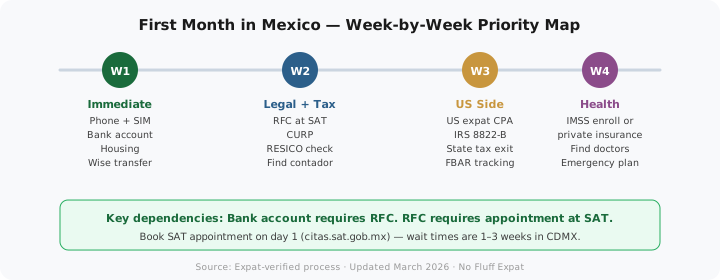
This is the condensed version. The PDF guide breaks this into a week-by-week timeline with specific SAT office addresses, required documents per step, and ready-to-send email templates.
Week 1: Immediate Setup
- Get a Mexican phone number — Telcel or AT&T Mexico prepaid SIM (~$10–15/month). Needed for bank verification, Uber, SAT appointments.
- Open a Mexican bank account — bring all documents to BBVA or Citibanamex. Get debit card same day if possible.
- Secure housing — furnished apartments are standard for newcomers. Budget 1–3 months deposit.
- Set up Wise (TransferWise) — for transferring money from US accounts at mid-market exchange rates.
Week 2–3: Legal & Tax Foundation
- Register for RFC at SAT — book appointment at sat.gob.mx. Bring passport, residency card, proof of address.
- Get CURP — if you have residency, it's on your card. Otherwise register at renapo.gob.mx.
- Evaluate RESICO eligibility — if self-employed under 3.5M MXN/year, enroll during RFC registration.
- Find a contador — Mexican accountant for monthly SAT filings. Cost: $100–$300 USD/month.
Week 3–4: US Side & Health
- Contact a US expat CPA — your US tax situation is now more complex. Book consultation before next deadline.
- Enroll in IMSS or get private health insurance — IMSS requires in-person visit to local subdelegación.
- File IRS Form 8822-B — notifies the IRS of your new mailing address.
- Review state tax obligations — CA, VA, NM, SC may still tax you. Check your state's exit rules.
- Start FBAR tracking — record maximum balance in every Mexican account for FinCEN 114.
The PDF guide includes the complete first-month checklist with exact addresses for CDMX, Mérida, Guadalajara, and Oaxaca SAT offices — plus ready-to-send email templates for banks, accountants, and immigration lawyers.
Get the Mexico Guide — $19 $27