Tax Obligations: US + Canada (Dual Filing)
If you are a US citizen or green card holder living in Canada, you owe taxes to both countries. The US taxes worldwide income regardless of where you live - this obligation does not end when you move abroad (IRS Publication 54). Canada taxes residents on worldwide income once you establish tax residency.
When does Canadian tax residency start? Canada uses a "significant residential ties" test - not a simple day count. If you establish a home, have a spouse/dependents in Canada, or have social and economic ties, you are a Canadian tax resident. The CRA considers your "centre of vital interests" - and 183+ days of physical presence creates a strong presumption of residency.
Canadian Federal Income Tax Rates - 2026
| Taxable Income (CAD) | Federal Rate | Notes |
|---|---|---|
| $0 - $57,375 | 15% | Basic personal amount (BPA): C$16,129 non-refundable credit reduces tax for all residents |
| $57,376 - $114,750 | 20.5% | - |
| $114,751 - $158,519 | 26% | - |
| $158,520 - $220,000 | 29% | - |
| Over $220,000 | 33% | Top federal rate - add provincial rate for total combined rate |
Combined Federal + Provincial Top Marginal Rates - 2026
Provincial income tax is calculated separately and added to federal tax. The combined top marginal rate is the key figure for Americans comparing Canadian tax against their US liability when calculating available Foreign Tax Credits.
| Province | Top Combined Rate | Top Rate Threshold (CAD) | Notes for Americans |
|---|---|---|---|
| Ontario | 53.53% | $220,000+ | Most common US expat destination - top combined rate fully offsets US tax via FTC |
| British Columbia | 53.5% | $252,752+ | Vancouver and Victoria - high housing offset by strong FTC |
| Quebec | 53.31% | $119,910+ | Highest at typical incomes - separate Revenu Québec return; French required |
| Nova Scotia | 54% | $150,000+ | Growing US expat community; HST 15% |
| Alberta | 48% | $355,845+ | Lowest for high earners; no provincial sales tax (GST-only) |
| Manitoba | 50.4% | $100,000+ | - |
| Saskatchewan | 47.5% | $49,720+ | Lower top rate threshold; significantly lower cost of living |
| Newfoundland & Labrador | Up to 58.75% | $1,000,001+ | Highest combined rate in Canada at very high incomes |
These are marginal rates - only the income within each bracket is taxed at that rate. For most Americans earning in the $60,000-$150,000 CAD range, the effective combined rate is 30-42%. This is higher than US rates on the same income - which is exactly why the Foreign Tax Credit (not FEIE) is almost always the optimal US tax strategy in Canada. For a deep dive, see our full US-Canada cross-border tax guide →
The RRSP & PFIC Trap - Canada's Hidden Tax Bomb
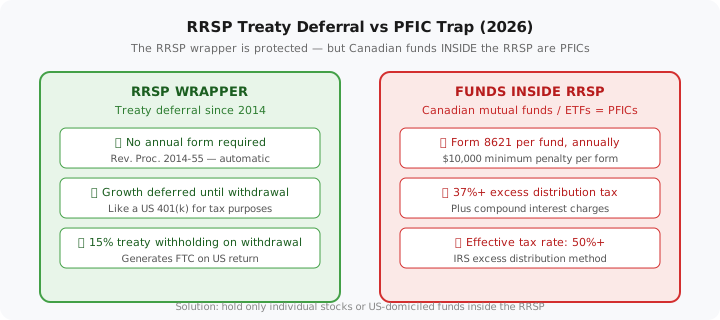
The Registered Retirement Savings Plan (RRSP) is Canada's equivalent of a US 401(k) - pre-tax contributions, tax-free growth, taxable withdrawals. Since 2014 (Rev. Proc. 2014-55), the IRS grants automatic treaty deferral on RRSP and RRIF growth - no annual Form 8891 needed. But two serious traps remain.
| Issue | With Correct Treaty Deferral | If Holding Canadian Funds Inside RRSP |
|---|---|---|
| IRS treatment | Treaty-protected deferred retirement plan - treated like a 401(k) | Individual Canadian mutual funds/ETFs inside RRSP are PFICs - Form 8621 required per fund annually |
| Tax on RRSP growth | Deferred until withdrawal - no annual US tax | 37%+ punitive PFIC excess distribution rate on gains, plus compound interest charges |
| Form required | No annual form required since 2014 (Rev. Proc. 2014-55) | Form 8621 per PFIC fund held - $10,000 minimum penalty for late/missing filing |
| On withdrawal | Canadian withholding (15% treaty rate) generates FTC on US return | Both countries tax on withdrawal; PFIC penalties compound the bill |
TFSA - Do Not Open This Account
The Tax-Free Savings Account (TFSA) is excellent for Canadians - but for US persons, the IRS classifies it as a foreign grantor trust requiring annual Form 3520 filing. The minimum penalty for failure to file Form 3520 is $10,000/year. Income inside the TFSA is NOT tax-deferred for US purposes - it is taxable on your US return in the year earned. The US-Canada treaty that protects RRSP treatment explicitly does not extend to TFSAs.
For the full RRSP, TFSA, and departure tax breakdown, see our Canada RRSP & PFIC Trap guide →
FBAR & FATCA Penalties for Americans in Canada
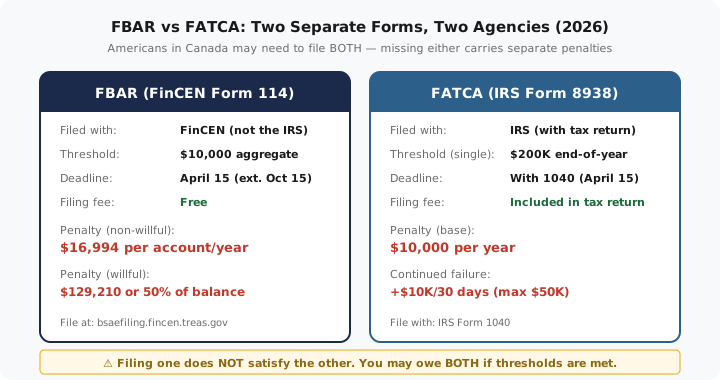
Two separate US reporting requirements apply to Americans with Canadian bank accounts. Canada is fully FATCA-compliant under the Canada-US Intergovernmental Agreement - Canadian banks report US-person accounts to the CRA automatically, and the CRA shares this data with the IRS.
FBAR (FinCEN Form 114)
If your Canadian bank accounts exceed $10,000 in aggregate at any point during the year, you must file an FBAR. This includes checking, savings, RRSPs, TFSAs, and investment accounts. The $10,000 threshold applies to the combined maximum balance across all foreign accounts, not per-account.
| Violation | Penalty | Notes |
|---|---|---|
| Non-willful failure to file | Up to $16,994 per account/year | Adjusted annually for inflation |
| Willful failure to file | Greater of $129,210 or 50% of account balance | Per account, per year |
| Criminal willful non-filing | $250,000 fine + 5 years imprisonment | Per 31 USC §5322 |
Filing deadline: April 15, with automatic extension to October 15. Filed electronically through FinCEN BSA E-Filing - separate from your tax return.
FATCA (Form 8938)
| Filing Status | End-of-Year Threshold | Any-Time-During-Year Threshold |
|---|---|---|
| Single / Married Filing Separately | $200,000 | $300,000 |
| Married Filing Jointly | $400,000 | $600,000 |
FATCA is filed with your tax return (Form 1040). Penalty for non-filing: $10,000 per year, plus $10,000/30 days after IRS notice (max $50,000). For the complete FBAR and FATCA filing walkthrough, see our FBAR & FATCA from Canada guide →
How to Avoid Double Taxation - FTC vs FEIE
In low-tax countries (Panama, Costa Rica, Colombia), FEIE (Form 2555) is the dominant US tax strategy. In Canada, where combined federal + provincial rates reach 47-54%, the Foreign Tax Credit is almost always the superior approach.
| Factor | FEIE (Form 2555) | FTC (Form 1116) |
|---|---|---|
| Max benefit (2026) | Excludes $132,900 earned income from US tax | Dollar-for-dollar credit for Canadian taxes paid - often eliminates US tax entirely |
| Income types covered | Earned income only | All income types (earned + passive) |
| Canada verdict | SUBOPTIMAL - Canadian rates exceed US rates, so FEIE wastes excess FTC | PREFERRED - Ontario 53% rate generates FTC exceeding US max rate of 37% |
| SE tax relief? | No - still owe 15.3% SE tax | Totalization agreement handles CPP vs SS - significant advantage |
| Child Tax Credit | KILLS the ACTC - lose up to $1,700/child in refundable credits | Preserves ACTC - families save $1,700+ per qualifying child |
| Revocability | Difficult - 5-year bar on re-election after revocation | Flexible - can switch strategies year by year |
Bottom line: Canada's high combined tax rates (47-54%) almost always make FTC the superior strategy. FEIE is rarely optimal in Canada and - once elected - is difficult to revoke (5-year bar). A family with 2 children using FEIE instead of FTC can lose $3,400+/year in refundable credits alone. Always model both with a cross-border CPA before filing.
Departure Tax - When You Leave Canada
When you cease to be a Canadian tax resident, the CRA deems you to have sold all worldwide property at fair market value on the departure date - triggering capital gains on unrealized appreciation. This includes investment portfolios, business interests, and appreciated assets. Principal residence is generally exempt. RRSPs are not subject to departure tax but become subject to 15% non-resident withholding (treaty rate) on future withdrawals.
Visa Options & Immigration Pathways - 2026
Unlike Panama or Costa Rica, Canada has no dedicated retirement visa. All immigration is managed by Immigration, Refugees and Citizenship Canada (IRCC). For most Americans, the pathways are Express Entry (skilled workers), family sponsorship, or the Super Visa for visiting parents and grandparents.
| Pathway | Duration | Key Requirements | Notes |
|---|---|---|---|
| Visitor (no visa needed) | Up to 6 months | Valid US passport | No eTA required for US citizens. 183+ days may trigger tax residency. |
| Express Entry (FSW) | Permanent (PR) | CRS score 480-540+; 1+ yr skilled work; IELTS/CELPIP | Points-based. Category draws for healthcare, STEM, trades. 6 mo from ITA. |
| Provincial Nominee (PNP) | Permanent (PR) | Province-specific requirements | PNP nomination adds 600 CRS points - virtually guarantees ITA. |
| Family Sponsorship | Permanent (PR) | Canadian citizen/PR sponsor; income requirements | Spouse: 12 mo processing. Parents: 20-30 mo, annual quota. |
| Super Visa | Up to 5 yrs/entry | C$100,000+ Canadian health insurance; sponsor income threshold | Parents/grandparents of Canadian citizens/PRs. NOT permanent residency. |
| Work Permit (employer-sponsored) | Tied to employer | LMIA or LMIA-exempt stream | Intra-company transfers, CUSMA professionals, international mobility. |
Permanent Residency → Citizenship
After receiving PR status, you must spend 730+ days in Canada in any 5-year period to maintain it. Citizenship requires 1,095 physical days in Canada during the 5 years before application, a language test, and a citizenship knowledge test. Canada allows dual citizenship - you keep your US passport. All IRS filing obligations continue regardless of Canadian citizenship status.
Cost of Living by City - Comparison Tables (2026)
Canada is significantly more expensive than most US cities for comparable housing and groceries. Toronto and Vancouver housing costs rival New York and San Francisco. Federal plus provincial income taxes reach 53%+ at top brackets. All figures in CAD with USD approximations at current rates (~0.73 USD/CAD).
| City | Monthly Budget (CAD) | Monthly Budget (USD) | Key Notes |
|---|---|---|---|
| Vancouver, BC | C$5,500 - $8,500 | $4,000 - $6,200 | Mildest climate; highest rent; large US expat community |
| Toronto, ON | C$5,000 - $8,000 | $3,700 - $5,900 | Largest economy; most US expats; high childcare costs |
| Victoria, BC | C$4,500 - $6,500 | $3,300 - $4,800 | Walkable; strong retiree community; limited rental supply |
| Ottawa, ON | C$4,200 - $6,000 | $3,100 - $4,400 | Capital city; bilingual; good value vs Toronto |
| Calgary, AB | C$4,000 - $6,000 | $2,900 - $4,400 | No provincial sales tax; lowest tax burden; growing tech sector |
| Montreal, QC | C$3,500 - $5,500 | $2,600 - $4,000 | Most affordable major city; highest provincial tax; French required |
| Halifax, NS | C$3,200 - $4,800 | $2,400 - $3,500 | Most affordable; Atlantic lifestyle; 15% HST |
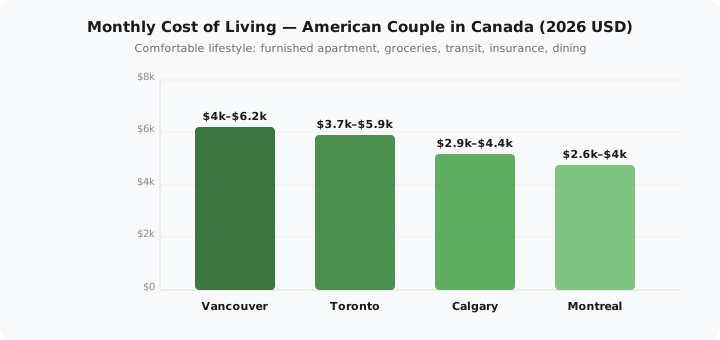
Housing dominates: A 1BR in Vancouver runs C$2,400-$3,500/month; Toronto C$2,200-$3,200; Montreal C$1,400-$2,000. Groceries are 15-25% higher than the US average (dairy especially expensive due to supply management). Gas is C$1.50-$1.90/litre (~$5.70-$7.20/gallon). Mobile plans are among the most expensive in the developed world.
Which Canadian Banks Accept Americans in 2026
Canada's Big Six banks are all FATCA-compliant and generally accessible for Americans - significantly easier than Latin America or most European countries. However, investment products at Canadian banks must be approached with extreme caution due to PFIC exposure.
| Bank | US-Friendliness | Best For | Key Notes |
|---|---|---|---|
| RBC (Royal Bank) | ✅ High - cross-border program | Americans with ties to both countries | Open Canadian account from the US before moving via RBC Cross-Border Banking |
| TD Bank | ✅ High - US + Canada operations | Americans already banking with TD in the US | TD Bank USA in eastern US; accounts can be coordinated cross-border |
| BMO (Bank of Montreal) | ✅ Moderate-High | Cross-border clients | BMO Harris Bank in the US for some cross-border coordination |
| Scotiabank | ✅ Moderate | General banking needs | Strong digital banking; FATCA compliant |
| CIBC | ✅ Moderate | General banking | CIBC Bank USA for US-side coordination |
| EQ Bank (digital) | ✅ High | High-interest savings | Digital-only; excellent GIC rates; no physical branches |
Required documents: US passport, Social Insurance Number (SIN), SSN + W-9, Canadian address proof, and immigration status document. Tip: RBC's Cross-Border Banking program lets you open a Canadian account from the US before establishing Canadian residency - eliminates the gap period. Do NOT invest in Canadian mutual funds or Canadian-listed ETFs - they are PFICs under IRS rules (50%+ effective tax rate on gains). Keep investments in US-domiciled funds at your US brokerage.
Property - NRST, FHSA & Foreign Buyer Rules
Canada's Prohibition on the Purchase of Residential Property by Non-Canadians Act (effective January 2023, extended to January 2025) banned non-residents from purchasing most Canadian residential property. As of 2026, the ban has expired but the Non-Resident Speculation Tax (NRST) remains in Ontario and British Columbia.
| Province | NRST Rate | Who Pays | Who Is Exempt |
|---|---|---|---|
| Ontario | 25% of purchase price | Foreign nationals without Canadian citizenship or PR | Canadian citizens, PRs, some work permit holders |
| British Columbia | 20% (Metro Vancouver+) | Foreign nationals and foreign entities | Canadian citizens and PRs - Americans with PR are exempt |
| Other provinces | 0% | N/A | No provincial restriction; standard property transfer taxes |
FHSA warning for Americans: The First Home Savings Account (FHSA) launched in 2023 - tax-deductible contributions with tax-free withdrawals for qualifying home purchases. The IRS has issued no specific guidance on FHSAs as of 2026. It is likely classified as a foreign trust (similar to TFSA) requiring Form 3520 filing ($10,000 minimum penalty). Do not open an FHSA without consulting a cross-border CPA first.
Healthcare - Waiting Periods & Coverage Gaps
Canada's provincial health insurance provides universal coverage - but not on Day 1. Most provinces impose a 3-month waiting period. During this gap, all medical expenses are your personal financial liability. A single emergency visit costs C$800-$2,000+ without coverage; a major procedure can be C$40,000-$100,000+.
| Province | Wait Period | Program | Notes |
|---|---|---|---|
| Alberta | No wait | AHCIP | Register immediately - card issued within days |
| Quebec | No formal wait | RAMQ | Card takes 6-8 weeks; coverage begins from registration date |
| British Columbia | 3 months | MSP | Register on arrival; 3-month clock starts from registration |
| Ontario | 3 months | OHIP | Register at ServiceOntario immediately; 3-month wait |
| Manitoba | 3 months | MB Health | - |
| Nova Scotia | 3 months | MSI | - |
| Saskatchewan / NB / PEI / NL | 3 months each | Varies | Register on arrival in all cases |
What's NOT Covered
Even after provincial coverage activates, dental care, vision care, most prescriptions, physiotherapy, and mental health therapy are not covered. Routine dental cleaning: C$150-$300. Prescriptions: C$20-$300/month without private insurance. Most employed Canadians get supplemental coverage through employer benefits. Self-employed Americans must purchase private supplemental insurance or pay out-of-pocket.
US Medicare in Canada
Medicare Parts A, B, and D provide virtually no coverage in Canada. If you suspend Part B while abroad, you face a permanent 10% premium increase for each 12-month gap upon re-enrollment. If you plan to return to the US within 5 years, suspending Part B may not be worth the lifetime penalty.
First Month in Canada - Checklist
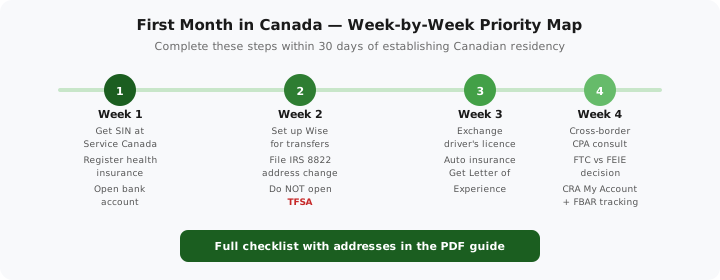
This is the condensed version. The PDF guide breaks this into a week-by-week timeline with specific office addresses, required documents per step, and ready-to-send email templates.
Week 1: Immediate Setup
- Get your Social Insurance Number (SIN) - Visit any Service Canada office. Bring passport + immigration document. Required for banking, employment, and taxes.
- Register for provincial health insurance - Province-specific office; bring passport, immigration document, SIN. Starts the 3-month waiting period clock.
- Confirm private health insurance is active - If you did not purchase gap coverage before landing, do it TODAY.
- Open a Canadian bank account - RBC, TD, or Scotiabank. Bring passport, SIN, SSN for W-9, proof of address.
- Register with STEP - US Embassy emergency notification at step.state.gov (free).
Week 2: Financial Setup
- Set up Wise account - For USD-to-CAD transfers at mid-market rates (saves 2%+ vs bank wire).
- File IRS Form 8822 - Notifies the IRS of your new Canadian mailing address.
- Update address on ALL US financial accounts - IRS, SSA, Schwab/Vanguard/Fidelity, credit cards.
- Do NOT open a TFSA - Document this decision in writing if bank advisors push it.
- Do NOT invest in Canadian mutual funds or ETFs - PFIC exposure is immediate. Keep US-domiciled investments.
Week 3-4: Residency, Tax & Compliance
- Exchange US driver's licence - Provincial licensing office. Get a notarized copy of your US licence BEFORE surrendering it.
- Consult a cross-border CPA - Your US tax situation is now significantly more complex. Book before next filing deadline.
- Confirm FTC vs FEIE election - In Canada, FTC is almost always preferred. Decide before filing.
- Set up CRA My Account - canada.ca/my-cra-account for T1 filing and correspondence.
- Start FBAR tracking - Record maximum balance in every Canadian account for FinCEN 114.
- Review state tax obligations - CA, VA, NM, SC may still tax you. Check your state's exit rules.
The PDF guide includes the complete first-month checklist with specific Service Canada office locations, provincial health registration addresses - plus ready-to-send email templates for banks, CPAs, and immigration lawyers.
Get the Canada Guide — $19 $27