Tax Obligations: US + Thailand (Dual Filing)
If you are a US citizen or green card holder living in Thailand, you owe taxes to both countries. The US taxes worldwide income regardless of where you live — this obligation does not end when you move abroad (IRS Publication 54). Thailand taxes residents on assessable income, which since January 2024 includes foreign income remitted in the same calendar year it is earned.
When does Thai tax residency start? Thailand uses a 180-day rule. If you spend 180 or more days in Thailand during a calendar year (January 1 – December 31), you are a Thai tax resident subject to PIT on assessable income.
Thai Personal Income Tax Rates — 2026
| Income Range (THB) | Rate | Approx. USD (at ฿35.7/$) |
|---|---|---|
| 0 – 150,000 | 0% | $0 – $4,202 |
| 150,001 – 300,000 | 5% | $4,202 – $8,403 |
| 300,001 – 500,000 | 10% | $8,403 – $14,006 |
| 500,001 – 750,000 | 15% | $14,006 – $21,008 |
| 750,001 – 1,000,000 | 20% | $21,008 – $28,011 |
| 1,000,001 – 2,000,000 | 25% | $28,011 – $56,022 |
| 2,000,001 – 5,000,000 | 30% | $56,022 – $140,056 |
| Over 5,000,000 | 35% | Over $140,056 |
These are marginal rates. Standard deductions (personal allowance 60,000 THB, spouse 60,000 THB, health insurance up to 25,000 THB) reduce net assessable income before rates apply. Many retirees end up with modest or zero Thai PIT liability. Thailand's VAT is 7% on most goods and services.
2024 Remittance Tax Rule — The Biggest Change for Americans in Thailand
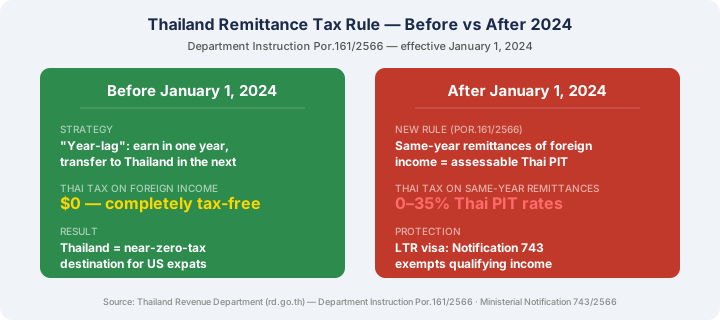
Department Instruction No. Por.161/2566 (effective January 1, 2024) is the most important Thai tax development in a decade for American expats. It eliminated the year-lag remittance strategy that made Thailand a near-zero-tax destination for decades.
| Period | Rule | Planning Strategy |
|---|---|---|
| Before Jan 1, 2024 | Foreign income remitted in a different year from when earned = tax-free. | "Year-lag" strategy: earn in one year, transfer in the next. |
| Jan 1, 2024 onwards | Foreign income remitted in the same calendar year earned = assessable at Thai PIT (0–35%). | Options: (1) LTR visa exemption, (2) transfer prior-year income only, (3) US savings buffer, (4) Schwab ATM withdrawals. |
LTR Visa Tax Exemption — Ministerial Notification 743/2566
| LTR Category | Exemption Provided | What Is NOT Exempt |
|---|---|---|
| Wealthy Pensioner | Qualifying pension, SS, investment income not remitted same year | Thai-source income; earned income from Thai sources |
| Work-from-Thailand (WFT) | Foreign-source employment income from non-Thai employer | Thai-source income; SE income from Thai clients |
| Wealthy Global Citizen | Foreign-source passive income not remitted same year | Thai-source income; same-year remittances outside criteria |
The PDF includes the complete 2024 remittance tax analysis with worked examples, LTR vs O-A tax comparison tables, and practical remittance timing strategies.
Get the Thailand Guide — $19 $27FBAR & FATCA Penalties for Americans in Thailand
Two separate US reporting requirements apply to Americans with Thai bank accounts. Thailand has a FATCA IGA with the US — Thai banks report US-person accounts to the Revenue Department (DIRD), which coordinates with the IRS.
FBAR (FinCEN Form 114)
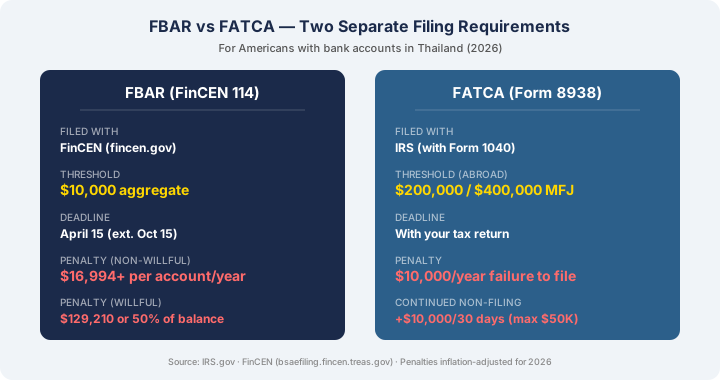
If your Thai bank accounts exceed $10,000 in aggregate at any point during the year, you must file an FBAR. The $10,000 threshold applies to the combined maximum balance across all foreign accounts, not per-account.
| Violation | Penalty | Notes |
|---|---|---|
| Non-willful failure to file | Up to $16,994 per account/year | Adjusted annually for inflation |
| Willful failure to file | Greater of $129,210 or 50% of account balance | Per account, per year |
| Criminal willful non-filing | $250,000 fine + 5 years imprisonment | Per 31 USC §5322 |
Filing deadline: April 15, with automatic extension to October 15. Filed electronically through FinCEN BSA E-Filing — separate from your tax return.
FATCA (Form 8938)
| Filing Status | End-of-Year Threshold | Any-Time-During-Year Threshold |
|---|---|---|
| Single / Married Filing Separately | $200,000 | $300,000 |
| Married Filing Jointly | $400,000 | $600,000 |
FATCA is filed with your tax return (Form 1040). Penalty for non-filing: $10,000 per year, plus $10,000/30 days after IRS notice (max $50,000).
How to Avoid Double Taxation: FTC vs FEIE in Thailand
The US-Thailand tax treaty (1996) and two IRS mechanisms — the FEIE and FTC — prevent double taxation. Post-2024, the optimal strategy depends on your visa type and remittance pattern.
| Strategy | Analysis for Thailand |
|---|---|
| FEIE (Form 2555) | Standard for most expats. Excludes up to $132,900 (2026). For LTR holders with Notification 743 exemption: Thailand charges $0 → FEIE remains primary tool. |
| FTC (Form 1116) | Post-2024: if Thailand taxes same-year remitted income at PIT rates (up to 35%), those Thai taxes generate FTC credit. For LTR holders: $0 Thai tax → $0 FTC → use FEIE instead. |
| Combined approach | Some income taxable in Thailand (same-year remittances → FTC) and some not (LTR-exempt → FEIE). A dual-qualified US-Thailand CPA is essential post-2024. |
Self-Employment Tax Trap — No Totalization Agreement
No US-Thailand totalization agreement means full 15.3% US SE tax on net self-employment earnings. At $100,000: $14,130/year in SE tax alone. The FEIE does NOT reduce this.
Visa Options: O-A, LTR, Elite & DTV (2026)
Thailand has no single "retirement visa" — instead it offers several overlapping programs. Your visa choice directly affects tax exposure, work rights, and quality of life.
| Visa Type | Duration | Income Requirement | Tax Benefit | Best For |
|---|---|---|---|---|
| O-A Retirement | 1 year (annual renewal) | 800,000 THB (~$22,400) or 65,000 THB/mo | None — 2024 rule applies fully | Retirees 50+; most accessible |
| LTR Wealthy Pensioner | 10 years (5+5) | $80K/yr passive or $40K + $250K assets | Notification 743 exemption | Best tax protection for retirees |
| LTR Work-from-Thailand | 10 years (5+5) | $80K+/yr from non-Thai employer | Notification 743 exemption | Remote workers; professionals |
| Thailand Elite | 5–20 years | No income req; ฿600K–฿2M purchase | None | Those below LTR/O-A thresholds |
| DTV (Digital Nomad) | 5 years (180-day stays) | ~$80K/yr or equiv. savings | None — no Notification 743 | Remote workers below LTR threshold |
Cost of Living by City — Comparison Tables
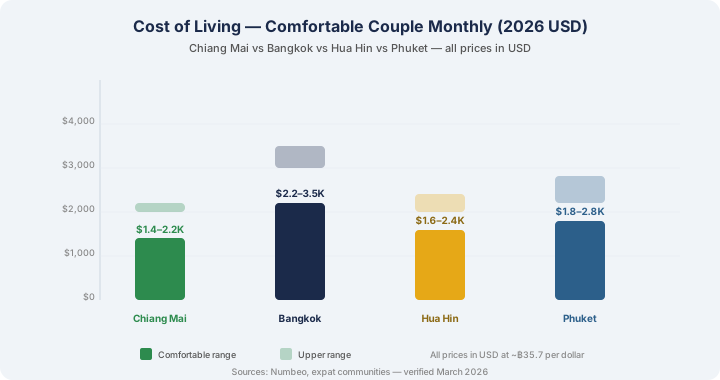
Thailand offers outstanding quality-to-cost ratios, especially in Chiang Mai — consistently ranked one of the world's best-value cities for expat living.
| City | Monthly Budget | Notes |
|---|---|---|
| Chiang Mai | $1,400–$2,200 | Best value; cool climate; largest expat community; WARNING: smoke Feb–Apr (AQI 200+) |
| Bangkok — Sukhumvit/Sathorn | $2,200–$3,500 | Full infrastructure; most expensive; excellent BTS/MRT |
| Bangkok — Lat Phrao/On Nut | $1,600–$2,400 | Outer Bangkok; BTS access; 20–30% cheaper |
| Hua Hin | $1,600–$2,400 | Beach town 2.5 hrs from Bangkok; popular retiree destination |
| Phuket — Rawai/Chalong | $1,800–$2,800 | Beach lifestyle; seasonal pricing |
| Pattaya — Jomtien | $1,300–$2,000 | Budget beach option; close to Bangkok |
| Koh Samui | $1,700–$2,500 | Island lifestyle; smaller community |
| Khon Kaen / Udon Thani | $900–$1,400 | Lowest cost; limited English infrastructure |
Which Thai Banks Accept Americans in 2026
Thai banking requires a Non-Immigrant visa at most banks. FATCA compliance means US-person accounts are reported — expect SSN and W-9 requests.
| Bank | Accessibility | Best For | Notes |
|---|---|---|---|
| Bangkok Bank | High | Primary expat banking | Most expat-friendly; English service; New York branch |
| Kasikorn Bank | High | Digital-forward | Excellent KPlus app; widely used by expats |
| SCB | Moderate-High | General banking | Good ATM network; SCB Easy app |
| Krungthai Bank | Moderate | O-A visa deposits | Government-linked; recognized by Immigration |
| Method | Rate | Speed | Best For |
|---|---|---|---|
| Wise (wise.com) | Mid-market + 0.5–1% | 1–2 days | Regular monthly transfers |
| Bangkok Bank NY wire | Competitive (direct) | 1–2 days | Large transfers to Bangkok Bank |
| Charles Schwab ATM | Mid-market; fees reimbursed | Instant | Daily cash; all Thai ATMs |
Property: Why Foreigners Cannot Own Land in Thailand
Foreign nationals cannot own land freehold in Thailand under the Land Code Act — regardless of wealth, visa status, or marriage to a Thai national.
| Option | Description | Key Notes |
|---|---|---|
| Condominium ownership | Up to 49% of building floor area can be foreign-owned. Funds transferred from abroad (FET form). Chanote title required. | Bangkok Sukhumvit: $150K–$500K+; Chiang Mai: $60K–$200K; Phuket: $150K–$1M+ |
| 30-year leasehold | Registered at Land Department. Renewal options are contractual, not legally guaranteed. | Enforceability beyond 30 years is contested under Thai law. |
| Thai company | Compliant company can own land. | Triggers Form 5471 ($10K/yr penalty). Do NOT use nominees — illegal and prosecuted. |
Healthcare Options & Costs
Thailand's private hospital system is internationally recognized — JCI-accredited hospitals deliver specialist care at 20–40% of US costs.
| Service | Thailand (USD) | US Equivalent | Notes |
|---|---|---|---|
| GP consultation | $40–$80 | $150–$350 | Bumrungrad walk-in ~$50–$80 |
| Specialist visit | $80–$160 | $250–$600+ | Cardiologist, dermatologist |
| Full blood panel | $60–$150 | $300–$800 | Metabolic, CBC, lipids, thyroid |
| Hip replacement | $12,000–$20,000 | $40,000–$120,000+ | World-class medical tourism |
| Heart bypass (CABG) | $15,000–$30,000 | $80,000–$200,000+ | Bumrungrad cardiac centre |
| Root canal + crown | $400–$800 | $1,500–$4,000 | Many expats travel for dental |
Top hospitals: Bumrungrad International (Bangkok, 190+ nationalities), Bangkok Hospital Group (nationwide), Chiang Mai Ram Hospital, Samitivej Hospital (families). Insurance: O-A requires THB 400K inpatient / 40K outpatient. LTR requires $50,000 minimum. US Medicare does not cover Thailand.
First Month in Thailand — Checklist
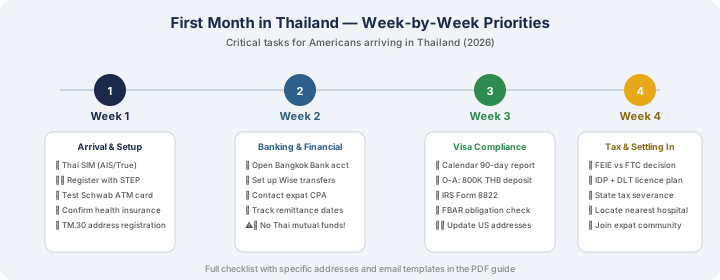
This is the condensed version. The PDF includes the complete checklist with specific addresses, required documents per step, and ready-to-send email templates.
Week 1 — Arrival & Setup
- Register with STEP at step.state.gov — US Embassy emergency notification
- Get Thai SIM card — AIS, DTAC, or True Move H
- Test Schwab ATM card at Bangkok Bank or KBank ATM
- Confirm health insurance is active for O-A / LTR compliance
- Register address (TM.30) — landlord/hotel does this within 24 hours
- Open Wise account (wise.com) if not already set up
Week 2 — Banking & Financial
- Open Thai bank account at Bangkok Bank or KBank — bring visa stamp, address proof, photos
- Transfer operating funds via Wise — avoid bank wire
- Update all US accounts: IRS, SSA, brokerages, credit cards
- File IRS Form 8822 (change of address)
- Document remittance strategy: same-year vs prior-year income transfers
- Do NOT invest in Thai mutual funds/REITs — PFIC trap
Week 3–4 — Visa & Tax Compliance
- Calendar 90-day reporting (O-A holders) — LTR holders exempt
- O-A holders: ensure 800,000 THB deposit is in place
- Consult US expat CPA — FEIE election, remittance rule, SE tax strategy
- Set up IRS Online Account at irs.gov/account
- Note FBAR obligation: Thai accounts over $10,000 → FinCEN 114 due April 15
- Confirm state tax severance for high-audit states (CA, NY, NJ)
The PDF guide includes the complete first-month checklist with specific addresses — plus ready-to-send email templates for banks, accountants, and immigration lawyers.
Get the Thailand Guide — $19 $27